

The curatorial and conceptual framework of the Traingle project was developed by Derya Yücel. Yücel, who also serves as the project’s coordinator, aims through this structure to establish a sustainable dialogue and a production-based model of collaboration between artists, curators, and collectors.
Each “triangle” consists of an independent artist, a curator, and a collector. Working together around the artist’s practice, each trio engages in a process of thinking, selecting, developing, and presenting. The 2025 edition brings together artists Rozelin Akgün, Şafak Şule Kemancı, and Sinem Dişli; collectors Banu Çarmıklı, Kına Demirel, and Leyla Pekin; and curators Dicle Beştaş, Melis Golar, and Nergis Abıyeva. While the exhibition allocates distinct spatial sections to each artist’s practice, these areas are further enriched by the curators’ conceptual frameworks and the collectors’ vision statements. In this way, visitors can navigate between diverse artistic approaches while experiencing each artist’s universe as a coherent and self-contained whole.

Şafak Şule Kemancı envisions an erotic queer ecosystem where the boundaries between being plant, mineral, human, or animal dissolve into fluidity. It is a journey into the lap of desire and exuberance, suspended between the artificial and the natural, the real and the imaginary.
In the Middle Eastern context, women are often given flower names, attributed with fertility, grace, and beauty. Yet naming women after flowers is in fact a form of domestication. In their works for the Üçgen project, Kemancı dismantles these multiple meanings attributed to flowers by playing with feminine archetypes. Kemancı fearlessly represents the taboo of sexuality and the body, celebrating it with a joy that unites all species. The language is genderless, rebellious, yet never devoid of tenderness. This is also made visible through choice of materials and techniques. In the practice, sculptural materials traditionally coded as masculine are softened and become fluid, while sidelined traditional methods and materials—often coded as feminine—are exalted and placed at the center of the artistic practice.

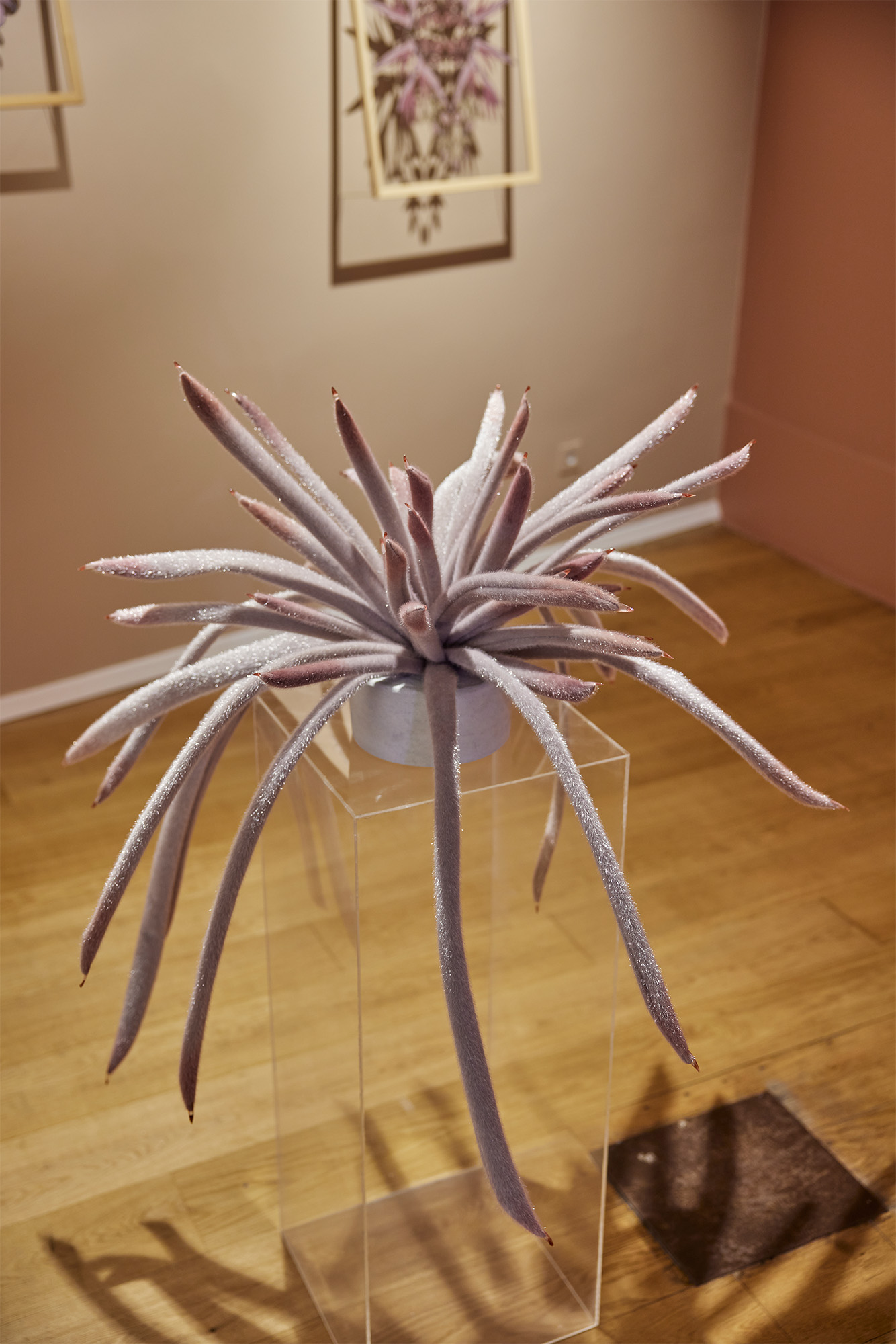
At the farthest corner of the gallery, confidently occupying its spot, grows a houseplant, a kind of succulent. At first glance, it seems unassuming: it does not take root deeply in the soil, confined within its pot, its roots trapped, swaying quietly in place. Its colors and textures are as sweet, soft, and velvety as a peach. Yet this is a trap Kemancı sets to draw the viewer closer. With its long red nails, restless and bursting with energy, this cracked creature takes on a hybrid form, part human, part plant. What we see—is it the succulent’s sprouting arms or a cluster of fingers emerging from the pot? This ambiguity is left to the viewer’s imagination. It reminds us that the human body may not exist solely within its own world, but can be rethought in another mode of movement. Defying all expectations of domesticity, it erupts through concrete, spilling out, asserting its presence. This exaggerated performance, in all its “excesses,” winks at non-normative intimacies, unspoken pleasures, and permeable desires that resist patriarchal order. The nails act as extensions of instinct; they grasp, beckon, and affect. Their eeriness does not diminish their seductive queerness nor their potent feminism.
In the series revisiting the traditional technique of glass painting, Kemancı once again conceals the details of human and plant bodies behind calm, innocent, and repetitive floral motifs. Inspired by the range of vulva tones from different individuals, a garden of proliferating, interwoven flowers is created that gently yet nobly affirms their own presence.
A rose, while beautiful and delicate, also protects itself with its thorns—embodying both pain and desire in a single form. When attributed to human beings, this name, along with all the cultural, historical, and literary meanings carried by other floral representations, is reimagined. Kemancı invites us to update these meanings, opening up the possibility of perceiving them as images of resistance, transformation, and polyphony.
T. Melis Golar
September, 2025
Artists: Rozelin Akgün, Sinem Dişli, Şafak Şule Kemancı
Courtsey of Derya Yücel, the artists and Rast Gallery , Triange, Istanbul, 2025
Photo Credits: Nazlı Erdemirel
For more information: https://www.instagram.com/rast.gallery/
Press reflections: https://www.unlimitedrag.com/post/sanatci-kurator-ve-koleksiyoner-arasinda-yeni-bir-ekosistem