

Suffix core- You are so cute, I wanna eat you!
It floated upward with its wholesome transparency and lightness, reflecting the light like a rainbow. Its oscillation slowed time, and the beholder fell under its spell, becoming absorbed into that suspended temporality. Cheerful yet marked by a swift fragility, it drifted on, while the rhythm of its motion hesitated to sustain its own existence. Its transience and glamour hovered in the air like a delicate, sugary charm. This lightness was as soothing as it was unsettling. It was precisely this dilemma that deprived it of its innocence.
The journey of the froth recalls the simulacrum1 of reality into which internet culture—now the most significant component of our daily lives—has drawn us. Today, as reality merges with the virtual environment, we have entered a posthuman era in which our bodies and minds have begun to evolve. Not only our bodies, but also our habits and obligations are shifting in parallel. The visual memory that shapes our online content flow, the advertisements we encounter on public billboards, designs, popularized objects, gestures, and even emerging terminologies are most actively utilized by Gen Z. Unaware of a life without the internet, this generation has become the developer of the very systems into which they were born, artistically and culturally transforming its landscape. Consequently, today’s field of imagery adapts and takes shape according to their sensory and emotional states. This condition affects our entire visual and mental sphere—from notions of popular culture to consumer goods, from body politics to conceptual tendencies. Even without belonging to this generation, we are inevitably involved in these domains, adapting to become more fluid, more inclusive, more diverse, and intensely colorful.

In this direction, today’s aesthetic codes drift beyond traditional standards, while new forms quietly position transformation at their core. Practices of “well-being,” such as following the “clean girl” trend—which distances itself from a world perceived as impure through organic nutrition, care routines, physical exercise, and spiritual practices—are becoming increasingly popular, as they cultivate meaningful connections with one’s circle while also fostering a sense of emotional safety. Within this aesthetic atmosphere, what appears silent, harmless, and inclusive coexists with what is wild, excessive, and assertive. For example, kawaii in Japanese popular culture—manifesting across entertainment, fashion, food, toys, personal appearance, and gesture—turns sweetness, beauty, and charm into a distinct genre, shaping the consumer habits of younger generations. Ephemeral and fluid forms that center the body illuminate alternative pathways toward imagining new worlds. Expressing oneself through everyday objects, with an almost effortless ease, emerges as a defining gesture. Rather than reproducing the aura, this tendency disperses it; instead of elevating culture, it brings it closer to the ground, setting it into a circulation rooted in contact and immediacy.2 Irony seeps into these aesthetic codes. As a result, what might appear as a simple regime of beauty gradually reveals a politicized field of values.
In English, the word cute derives from acute, a term that originally denotes mental sharpness, alertness, and quickness. Through a subtle process of diminishment and condensation, this sharp intensity folds back on itself, undergoing an uncanny reversal that gives rise to meanings of smallness, softness, accessibility, and apparent harmlessness.3 In Turkish, by contrast, words such as sevimli, tatlı, and şirin define not the inherent quality of the object itself but the affect it produces in the other. In a similar manner, they open up a threshold—one that, when pushed toward excess, can drift from innocence into artificiality, and even toward the quietly unsettling.
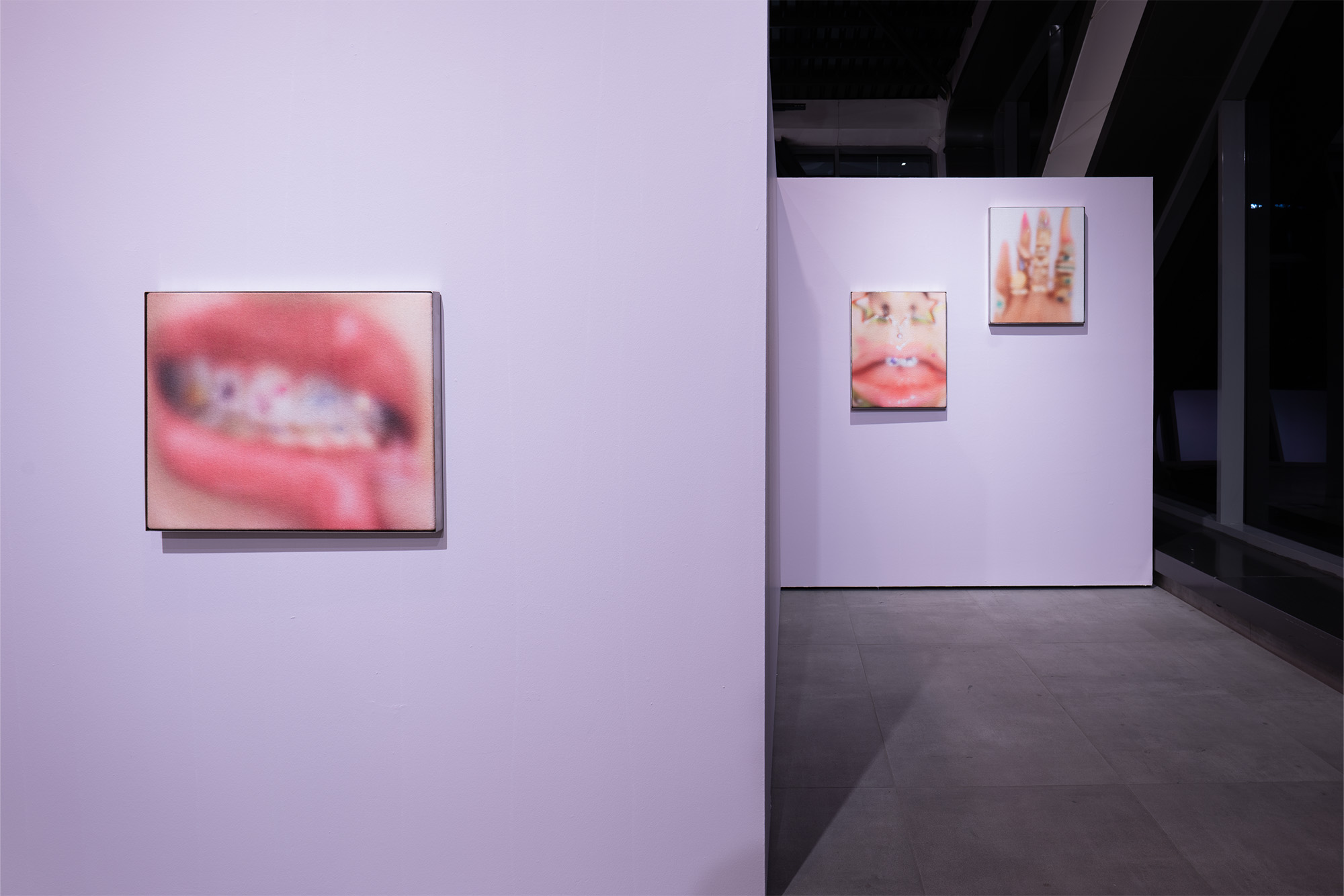
The tension between these contrasting meanings and acts of attribution also forms the conceptual basis for the exhibition’s two spatial modes. The froth metaphor, referring to the upper floor, reflects the bright and seductive surface of digital culture; the ground floor, through the metaphor of tar, points toward the zones where this aesthetic darkens, grows strange, and becomes uncanny. It is no coincidence that the first chapter of the exhibition takes its title from Froth on the Daydream by Boris Vian. The world Vian constructs in the novel operates through the very tension described above. Everyday scenes seem to call out from within a dream; playful and sweet humor never quite lets go, even as it carries an undercurrent of fragility and melancholy. The way spaces shift according to emotional states, the depiction of objects as if they were living beings, and the presence of tangible, spatial counterparts to inner moods all resonate within the exhibition’s installation.
On the ground floor, Şafak Şule Kemancı’s flower sculpture welcomes the viewer, fluidifying the boundaries between being human and being plant. Suspended between the artificial and the natural, the real and the imagined, the work recalls the ways desire, exuberance, and vanity take shape across different bodies. Başak Çalışır’s colorful images, captured from everyday life, underline the fragmented, cute, and fleeting states of ordinary and brief encounters. The transformation of the body within the digital realm materializes in Christiane Peschek’s paintings on plush fabric. The artist approaches social media as an extension—almost a prosthetic limb—of the physical body. Blurred body fragments refer to the body’s secondary existence on the internet and to identity’s increasing fluidity. Pınar Kayar’s two-headed, two-bodied horse sculpture, titled Hope, with its shiny and soft surface, appears playful, harmless, and unhurried, carrying the space toward a dreamlike atmosphere. Alla Güner paints the very bubble that drifts through the dreamlike skies described in Vian’s novel.Offering an alternative to the absence of spring, Merve Morkoç activates a wearable sculpture that allows one to physically inhabit the sensation of spring in a continuous loop. Through her sculpture Take Care of My Water and Yourself, she articulates the body’s potential states—its hybridity and transformability—through the use of fur, bra hooks, and the accumulation of rounded organic forms. Her photographic series Not My Birthday consists of stills extracted from the video performance (Çünkü) No One Cries Forever, which follows the series of events from a birthday girl until she blows out the candles. This birthday shares ironic moments within a deliberately kitsch aesthetic. Through his video The Story of Writing (ASMR)4, Berkay Tuncay reinterprets the relationship between the displacement of writing in the digital age and the growing dominance of the visual, employing the now-popular ASMR5 technique. A book examining the history of writing, originally published in 1932, is fragmented into a five-channel video installation in which the continuous typing of its text on a keyboard initially produces a meditative experience, only to become overwhelming through its persistent sound and imagery. The works on the upper floor, both through their material choices and their conceptual frameworks, speak from within a luminous and seemingly harmless dream—somewhere between reality and imagination, beneath a rainbow.

It spread slowly, veiling the light; where it settled, time thickened rather than flowed. The trace it left behind clung like black gum, and its state lingered in an ambiguity between solid and liquid. Those who touched it found their movement delayed; it carried an uncanny weight. Its persistence made it not only heavy but also accountable, for the stubborn mark it left behind demanded a witness. Escaping it was almost impossible; its presence gradually made everything around it its own. This weight was as dominant as it was persuasive. It was precisely this silent insistence of permanence that deprived it of its innocence.
The spread of tar signals the emergence of an uncanny, almost paranormal atmosphere. In turn, it calls the subject into a state of heightened attention—sharp, alert, and cautious; in other words, acute. As mentioned above, there is an underlying power relation within cuteness. What is deemed “cute” acquires this attribute through the gaze of power, sustaining its existence within a position that is harmless, dependent, and in need of protection. As this asymmetry takes form, relationships and roles may at times become exaggerated. Sianne Ngai points to the ambivalent nature of cuteness, which can provoke impulses that verge on the sadistic—such as the urge to squeeze, to over-love, or even to bite.6 The well-known cartoon character Elmyra Duff offers a striking example of this tendency. The unease within this dual structure does not reside solely with the one who holds power; it can also affect the one perceived as familiar, safe, and vulnerable. Masahiro Mori7 conceptualizes this dynamic through the notion of the uncanny valley, describing how emotional responses intensify or diminish as an object approaches human likeness. That which appears most familiar and trustworthy may, at a certain threshold, become unsettling precisely because of its realism. Hyper-realistic baby dolls, for instance, often acquire a disturbing presence. A similar condition emerges within the digital sphere: in the posthuman era, hybrid bodies are identified not only as cute, extravagant, and luminous, but also as indeterminate, uncanny, enigmatic, and at times disturbing.
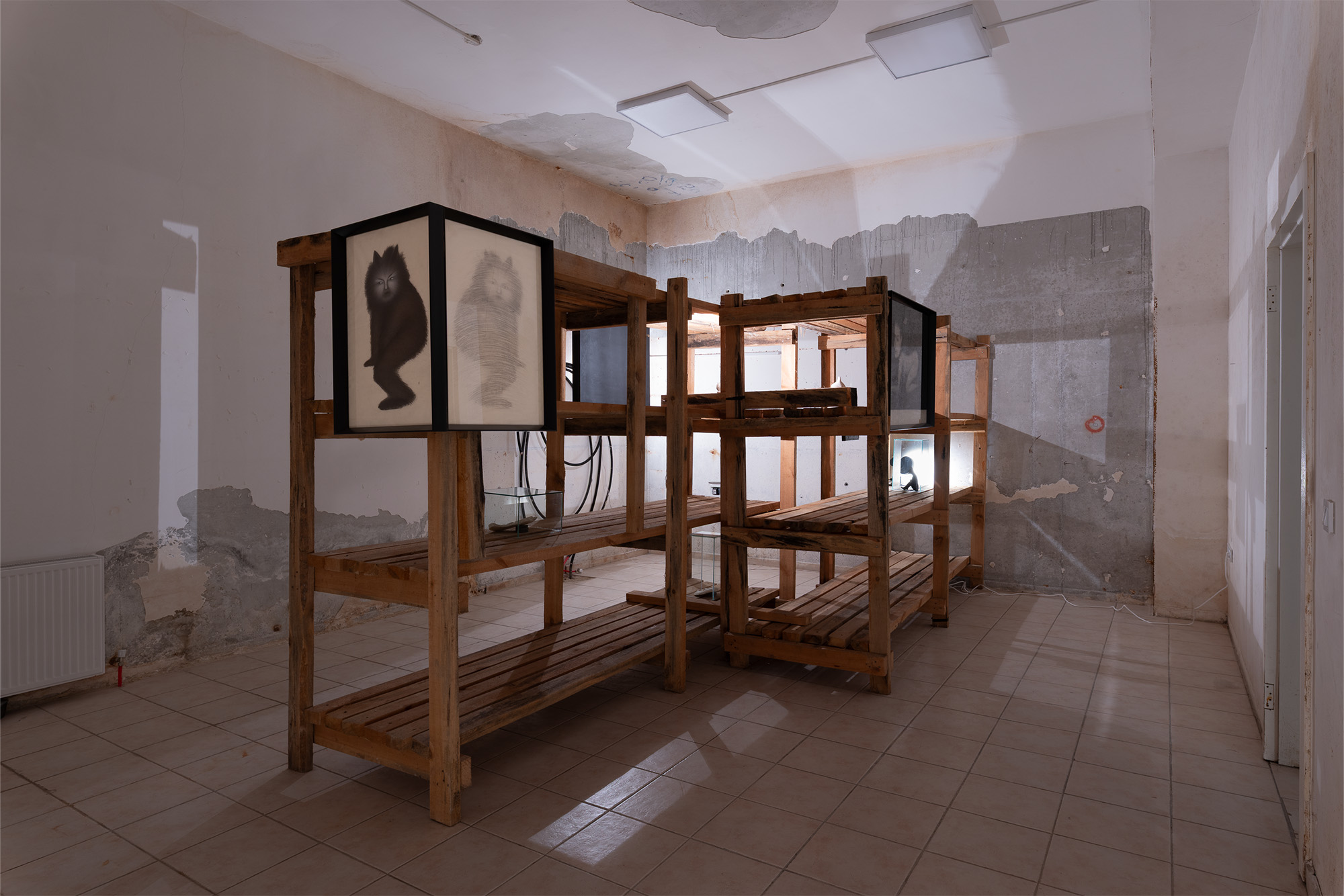
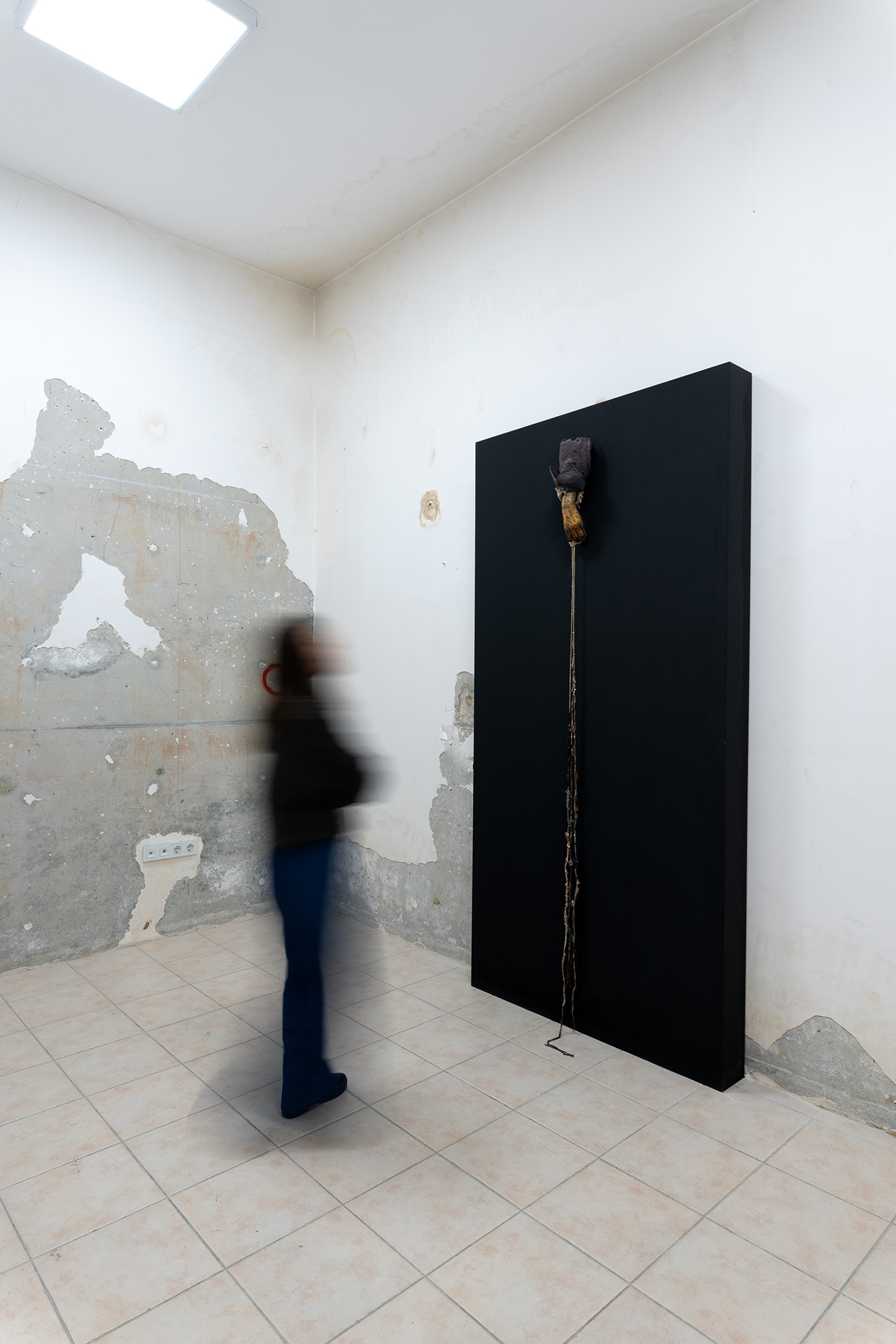
The dinginess of the underground space seeps into the floors and walls, recalling a long-forgotten cellar—damp, dark, and stained with time. In the room where Metehan Törer’s works are installed, Monsters Foot grips the space with its claw, dominating it with full assertion. Törer’s The Other Flowers render meaningful the determined existence of “alienated” bodies—those that hell itself seems to welcome with a strange compassion. This becomes a landscape that is free, courageous, and overflowing. Escape from the Sky depicts a moment that attempts to confront the dark and isolating feeling of otherness. Şule Nur Alev approaches this darkness from a more abstract and geometric world. Six works from different series move between accumulation and dispersion, zooming in and out while oscillating between a final destination and nothingness. Extending from architectural elements to geometric forms, this dystopian universe is woven with a sophisticated sense of wisdom and meticulous detail. Can Yıldırım’s Daily Fallow presents a body held in suspension, aligned by networks of power. Acupuncture needles evoke a desire to continually reactivate the body, while the separation and disabling of its limbs create a palpable dilemma. Through this tension, the relationship between self-defense mechanisms and bodily healing rituals becomes visible. The room housing Mert Öztekin’s works spreads through the dark, dusty, and uncanny atmosphere of a cellar. Composed of portraits and soap sculptures, these works stare back from behind the darkness, offering an experience that shifts and wanders through haunted valleys. Much like wandering through the labyrinths of the deep web8, the images provoke discomfort, yet the irony embedded within them softens the tension. Günbike Erdemir’s drawing series Love’s Executioner, together with her ceramic works, revolves around themes of death, desire, and eroticism. With a fearless and transgressive visual language, the works shuttle between relations of authority and real, historical, and fictional characters. Taka Kono’s Hand with Three Strings rises on a monolithic structure, carefully fixing movement in place. The disturbing image leaves the trace of a hand as if marking the withdrawal of possibilities—as though an idea itself were attempting to erase them. Read together, the works on the ground floor unfold like a dead end within a nightmare. The space becomes populated with its own characters and ideas, revealing an outward expression of the mind’s deepest and darkest terrains.
Froth on the Daydream & Tar in the Cellar concludes as a reminder that cuteness does not solely produce innocence, nor does darkness generate threat alone. In a world where lightness and weight, transparency and density, desire and unease coexist, it is neither possible to be fully protected nor to feel entirely secure. The exhibition invites us to consider the flowing images of contemporary visual culture together with the affective undercurrents that accumulate beneath them, without separating one from the other. To remain at this threshold—to dare to stay within this oscillation that shapes today’s bodies, desires, and fears—is a crucial step toward understanding the world of Gen Z.
T. Melis Golar
January, 2026

1- According to Jean Baudrillard, the simulacrum is a term that describes not a copy of an original, but rather the reproduction of something that has no original, no reality, no primary instance. Much like in nature, where inanimate matter may, over time, come to resemble living forms, the simulacrum refers to that which is already a copy in itself—replicated once again.
2- Benjamin, W. (2008). The work of art in the age of its technological reproducibility, and other writings on media. Harvard University Press.
3- Ngai, Sianne. Our Aesthetic Categories: Zany, Cute, Interesting. Harvard University Press, 2012.
4- A book written by Bertha Parken in 1932.
5- ASMR, short for Autonomous Sensory Meridian Response, refers to a set of auditory, visual, and tactile stimuli that evoke calming and pleasurable sensations in the body. It has emerged as a widely popular phenomenon within internet culture.
6- Ngai, S. (2005). The cuteness of the avant-garde. Critical Inquiry, 31(4), 811-847.
7- Mori, M., MacDorman, K. F., & Kageki, N. (2012). The uncanny valley [from the field]. IEEE Robotics & automation magazine, 19(2), 98-100.
8- The term deep web refers to those parts of the internet that are not indexed by standard web search engines. In contrast to the “surface web,” which is accessible to anyone with an internet connection, it designates a domain that remains largely unseen and untraceable.
Artists: Başak Çalışır, Pınar Kayar, Merve Morkoç, Şafak Şule Kemancı, Christiane Peschek, Alla Güner, Berkay Tuncay, Metehan Törer, Günbike Erdemir, Şule Nur Alev, Mert Öztekin, Can Yıldırım, Taka Kono
Courtsey of the artist and Martch Art Project, Siyah Beyaz Gallery, Chi Art Gallery, Tankut Aykut Gallery and Sanatorium, Froth on a Daydream & Tar in the Cellar, Fikret Otyam Contemporary Art Center, 2026
For more information: https://www.cankaya.bel.tr/kultur-sanat/gunlerin-kopugu-ve-kilerdeki-zift