“The task of science is not to provide the truth.” — Bruno Latour
We walked.
We traced the borders of the field, listened to the wind, and went after the colors. Fixed on the horizon, our eyes looked beyond the vineyard.
Now, we turn our gaze close. We invite the artists to interpret the vineyard with a more systematic and investigative lens—to replace the telescope with a microscope, to observe the soil, the organisms, the grape, and the intricate functions of these symbiotic relationships. Here, the focus shifts to subterranean networks, microorganisms, symbiotic beings, and the pulsating flows that course through the vines. We are no longer just tracing the impressions the land leaves on us—we are questioning how we situate ourselves within it, how we affect it, and how it, in turn, affects us.
This second exhibition proposes a shift in scale—a deepening of focus. We now navigate not the surface, but the veins of the Barbare Vineyards. We invite you to see the invisible, to hear what is not readily heard, and to explore the micro-systems operating beneath the surface. At the heart of this approach lies the Gaia Hypothesis, which perceives the planet as a living body. The hypothesis envisions the atmosphere, earth’s crust, plants, animals, humans, and microorganisms as an interconnected whole—functioning like a single organism.
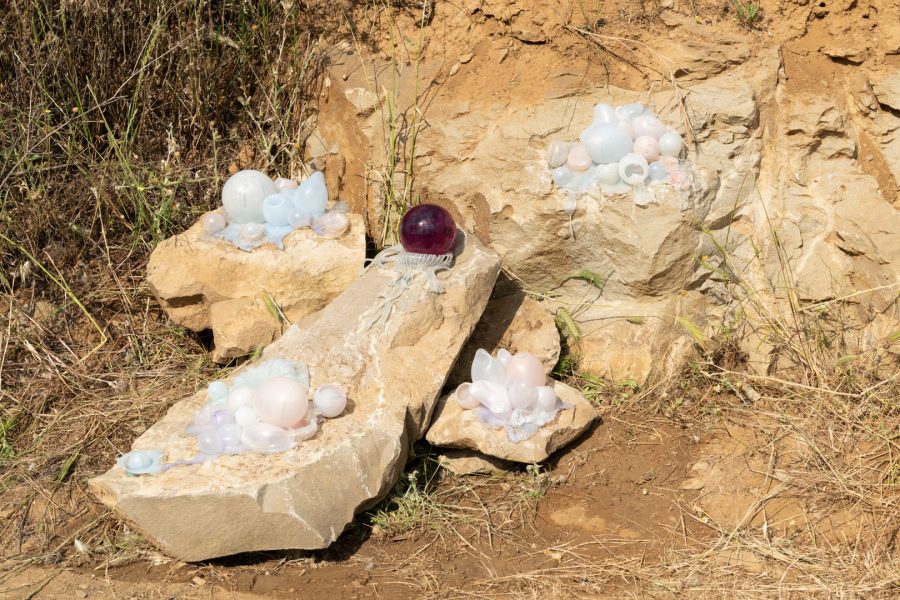
Pınar Marul, Petroflora, 2026, Silicone, epoxy, polyester resin, variable dimensions
The division between living and non-living dissolves; life becomes a network of relations flowing between parts. This understanding calls for a departure from objectifying views of nature and urges us to think and breathe with it. Rather than placing humans at the center, it sees us as active carriers within the system, and temporary inhabitants of a living planet. Instead of anthropocentric Western ideas, it focuses on the constructiveness of acting together and thinking as a whole—a perspective rooted not only in contemporary ecological thought but also in ancient cosmologies.
The aim here is not simply to sense the land’s call, but to think with it, to work with it, and to draw our timelines closer to the cycles of nature.
We take a second step.
Contact Zone is a conceptual field where different cultures touch, encounter, and transform one another. Rather than merely a spatial entity, it is a term to describe the connections, tensions, and exchanges among groups in touch. Under this title, we turn to our relationship with place, adding a new layer—moving inward, deeper, toward what lies beneath the surface. In our relationship with the land, we move into a new layer— inward, deeper. To listen to the life beneath the soil, to what the atmosphere carries, to the stories of beings whose voices we rarely hear.
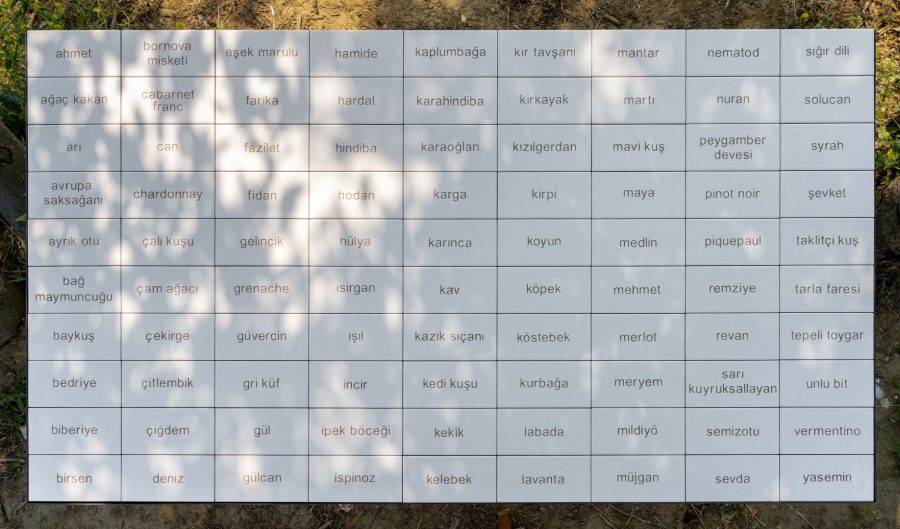
Yasemin Özcan, The Vineyard Table, 2026, Etched ceramic tiles, iron, poplar plywood, and hackberry wood, 75 x 135 x 75 cm
By incorporating the cultural, industrial, and artistic uses of ceramics into her own practice, Yasemin Özcan adopts a mode of production centered on soil, craftsmanship, and labor. Thinking about objects together with their memory, geography, and culture, she recalls both their uses and modes of production. Every small gesture she applies to ceramic offers a new perspective on the many states of earth and on living beings’ relationship with the earth.
Özcan participates in the exhibition Contact Zone with a table that embraces all living beings in the vineyard. A collectively prepared list of living beings, created together with the vineyard workers, dissolves the boundaries between species and the divide between human and non-human. The irony that is always present in Özcan’s texts becomes even more pronounced when read alongside the randomness of the list. In the table positioned among hackberry trees, the artist engraves onto the ceramic surfaces the protagonists who bear witness to everything the soil gives life to, nourishes, and makes possible. The list establishes no hierarchy between humans, animals, plants, and microorganisms; instead, it turns every active living being into a member of this table.
Earth enters the exhibition both as a building material and as an object that preserves the memory of biodiversity. While the industrial-standard production of ceramics is approached through the axis of singularity and multiplicity, the sameness of mass production also becomes associated with this list. The labor of the soil, the process that transforms it into ceramics, and the labor of the artist all become visible at this table. The table becomes a place of pause, inviting remembrance of invisible labor and the unseen relationships that connect living beings. The landscape before the table, meanwhile, becomes a threshold for contemplation opened up by the mountain, the stone, the vineyards, and the sky to which we belong and in which we are included.
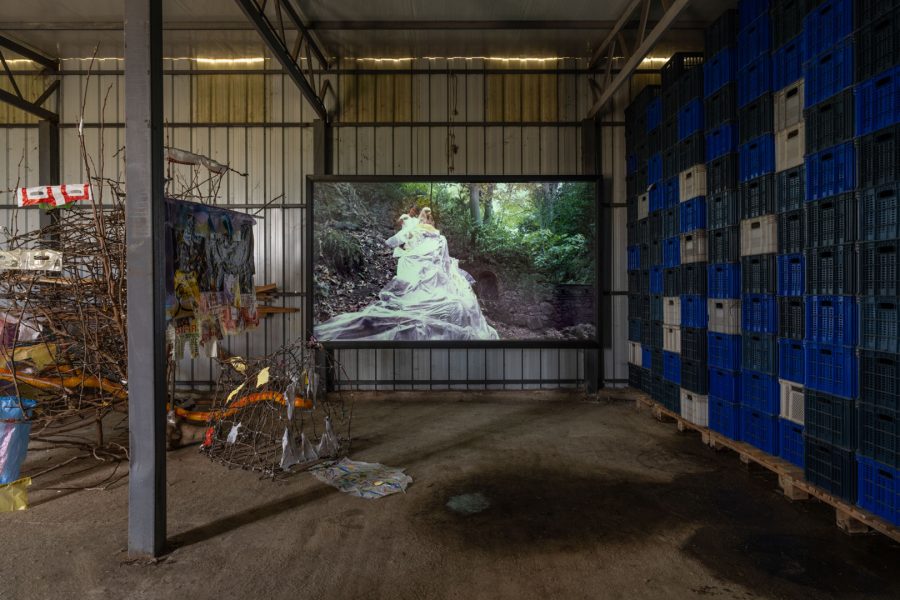

Ezgi Kılınçaslan, Vicious Cycle, 2021, Video, 15’56”
Ezgi Kılınçaslan explores relations of power and authority through oral history, memory, and the transforming nature of humanity. Through nature, myths, and political events, she examines the relationship humans establish with the “other,” while seeking ways to give bodily form to abstract concepts. Her experimental and process-oriented mode of production leads the artist at times toward research, and at others toward the pursuit of unexpected yet fruitful coincidences.
Vicious Cycle is a video work produced during K l nçaslan’s residency at Kulturakademie Tarabya during the Covid period. In the video, the character builds a living space out of plastic in the middle of a forest and inhabits an isolated life surrounded by plastics, a mobile phone, coffee ordered online, and an inanimate mannequin. Pieces of nylon became almost a natural component of all landscapes point to the various ways humans relate to plastic. Over time, the mannequin’s lifeless body becomes covered with pinecones, while the tent surface fills with raindrops, opening space for new forms of life. As the artist portrays the mannequin adapting to nature faster than humans do, the distinction between the “living” and the “non-living” becomes increasingly ambiguous, expanding further through sound, surfaces, vibrations, and textures. The piece recalls the devastation left behind by ecocide, as well as humanity’s entrapment within the endless cycle created by the very objects it produces. Is it possible for humans to see themselves as members of this system? Or is the more natural course to accept plastic as part of human nature and ultimately disappear along with it?
The accompanying installation, Mümtaz, is a semi-waste form composed of branches and trees emerging from the vineyard itself and situated within the storage space. Made from a found tree trunk and adorned with colorful plastics, this body manifests the hybrid states of being — half-living, half-inanimate — explored in the video. From one angle it resembles a bird with ornate feathers; from another, a dragon; at times, a many-eyed insect. Mümtaz becomes a representation of the contemporary mythology of plastic circulating through the micro-scales of nature.
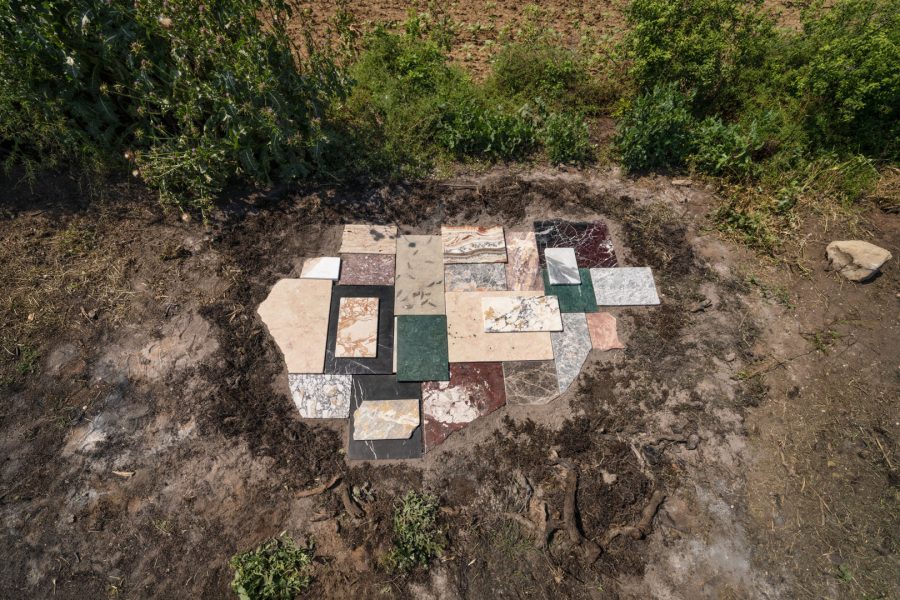
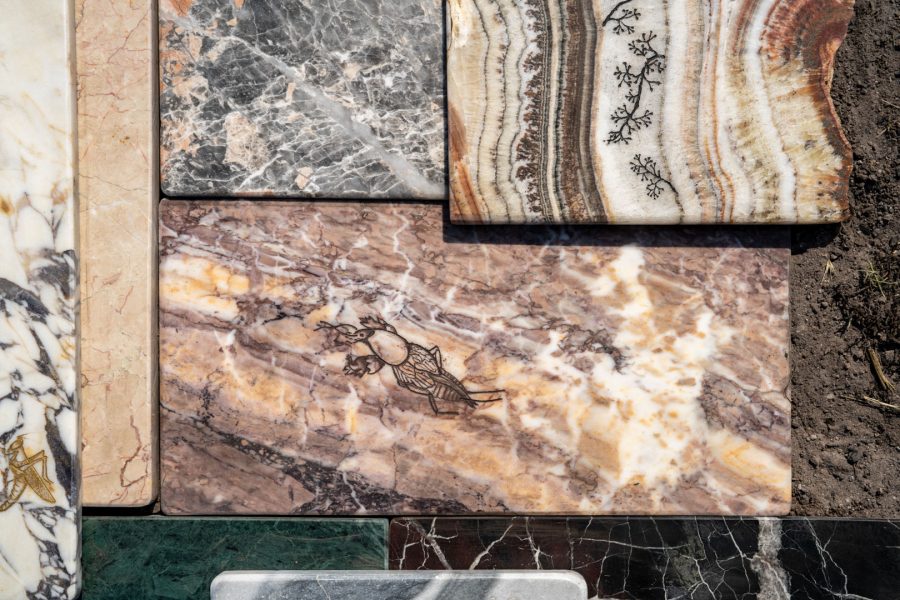
Kıymet Daştan, Grape Stalk, Fire’s Ash, 2026, Mixed media on marble, 315 x 210 cm
Kıymet Daştan’s practice examines memory and the representation of values through the concepts of materiality and temporality. Bringing methods of recording and erasing memory to the center of her practice, she attempts to recall stories. By visualizing narratives through the disappearance, erosion, and loss of matter, she reconstructs the object not merely as a remnant, but as a new mode of remembering.
Daştan’s proposal for the Contact Zone exhibition is situated in an area of the vineyard where grape waste and various organic residues are burned. Beginning from a site-specific idea, in Grape Stalk, Fire’s Ash the artist engraves patterns speculating on certain life forms onto marble surfaces of different textures and colors. Drawing from the Turkish idiom “Armudun sap , üzümün çöpü” (“Pear’s stem, grape’s stalk”)—an expression reflecting the selective and fault-finding tendencies of everyday language— she points to the living beings rendered invisible by anthropocentric agricultural practices that classify them as “harmful,” “waste,” or outside of the system. Marble, commonly used beneath stoves in homes as an object that prevents sparks and fires, plays an important role in the decision of the artist through serving as a geological library which archives the history of the earth layer by layer over time. All living residues, eradicated through post-harvest burning, re-emerge on these surfaces like fossil traces. In this way, the stone becomes an archive recording the vineyard’s suppressed ecology. Within the exhibition, which rereads life as a network of relationships flowing between pieces, the work offers back to the earth the traces of those reduced to ash and dispersed into the air, erased through poisoning.

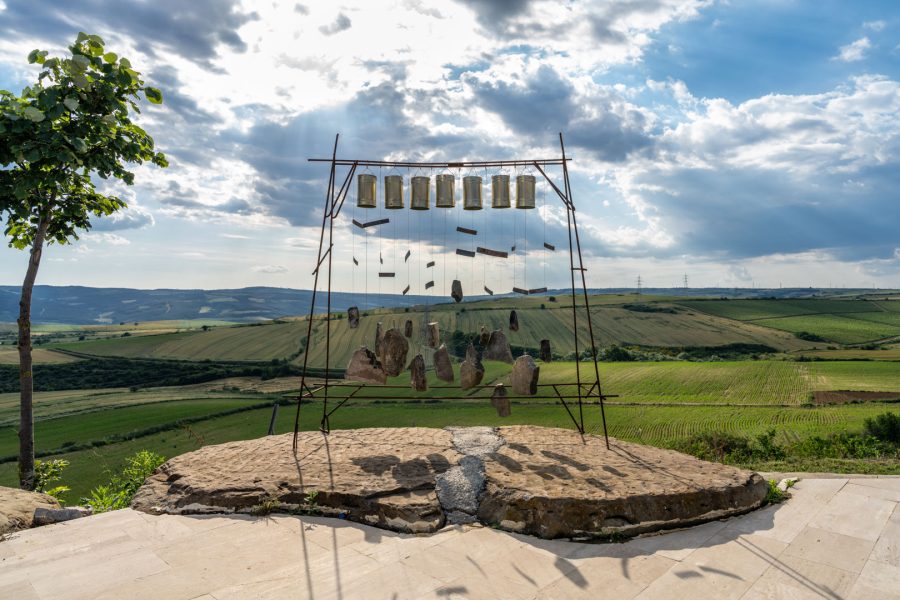
A.Serkan Aka, Gravity, 2026, Discarded bass guitar strings, found tin cans, stones found in the vineyard,
fragments of barrel hoops, steel cable, frame constructed from reclaimed steel rebar, 230 x 250 x 65 cm
A. Serkan Aka activates everyday objects through sculptural practice; by bringing movement together with sound, he constructs a performativity that is irregular, imperfect, and contingent. Drawing on found objects, his works unfold through an ambiguity that carries the unknown memory of the object rather than through systematic and predictable movements. Gravity is a sound installation activated through the collaboration of gravity, stones collected by Aka from the vineyard, tensioned strings, and the wind. The artist suspends stones gathered from the vineyard on strings, making the weight of each stone a determining element of the composition. The mass of the stones creates different tensions in the strings, allowing each stone to tune the sound in proportion to its own weight. The resulting frequencies form a temporary and ever-changing sonic field in which the gravitational force between the stone and the earth becomes audible.
The metal bands used in the work were made from iron hoops that once held wine barrels in shape. As these pieces are set in motion by the wind, they strike the strings and produce sound, while the tin cans attached to the tensioned strings resonate and amplify the vibrations. In this way, materials originally designed to preserve, stabilize, and control are displaced from their intended functions and become part of an unpredictable sound system. The stones, metal bands, and strings no longer serve to maintain a fixed order; instead, they enter into relationships shaped by wind, weight, and chance.
Semiophysical; The Vineyard as a Site of Vibrational Exchange, 2026
6-channel sound installation, 12’34”
Working primarily under the name Action Pyramid, Tom Fisher focuses on the interactions between human and non-human beings and on understanding how these relationships operate within broader ecological systems. Through a variety of recording techniques, the artist traces acoustic phenomena that often exist beyond the threshold of human hearing or become invisible within everyday senses. By questioning anthropocentric modes of perception, the artist invites us to reconsider concepts of scale, hierarchy, and agency.
Produced for the exhibition Contact Zone, Semiophysical brings together approximately twenty different vibrational insect calls recorded in the Barbare Vineyards together with resonances created by wind moving through the vineyard’s trellis wires, highlighting a field of communication that remains inaudible to the human ear yet continuously circulates within the vineyard’s ecological life.These vibrations, which travel through the vineyard and along the bodies of plants, relate to the field of biotremology, the study of signals that organisms produce, transmit, and perceive through substrates and surfaces. Action Pyramid reminds us of the existence of other forms of life and communication systems that operate independently of our awareness. At a time when some agricultural research seeks to develop methods for interfering with the vibrational communication of species categorized as pests or disease vectors, Semiophysical approaches these networks not as systems to be controlled but as ecological relationships that should be listened to and understood.The piece is also an open invitation to reflect on agricultural production, land use, and the forms of coexistence we cultivate with non-human beings.
- Artists: A. Serkan Aka, Action Pyramid, Ayça Ay, Egle Oddo, Elmas Deniz, Ezgi Kılınçaslan, Fırat Engin, İrem Apak, Kıymet Daştan, Orkan Telhan, Pınar Marul, Rozelin Akgün, Sinem Dişli, Tabita Rezaire, Yasemin Özcan
- Exhibition credit: Coursey of the artists and Barbare Studio, Contack Zone, Barbare Vineyard, Tekirdağ, 2024
- Exhibition photo credit: Zeynep Fırat
- For more information; barbarestudio.com
- Basında çıkanlar;